 《HEARIM · 헤아림》 Special Issue No. 1·Review & Bibliometric Note·Published 2026-10-05
AI use: searched, matched, plotted and drafted with Claude (Anthropic) in conversation with the editor; the editor chose the questions and approved publication. Korean edition prepared by Claude and checked number-for-number against this English text.
Three Records, One Household: A Bibliometric Reading of John F. Nash Jr., John C. M. Nash, and the Unindexed Work of Alicia Nash
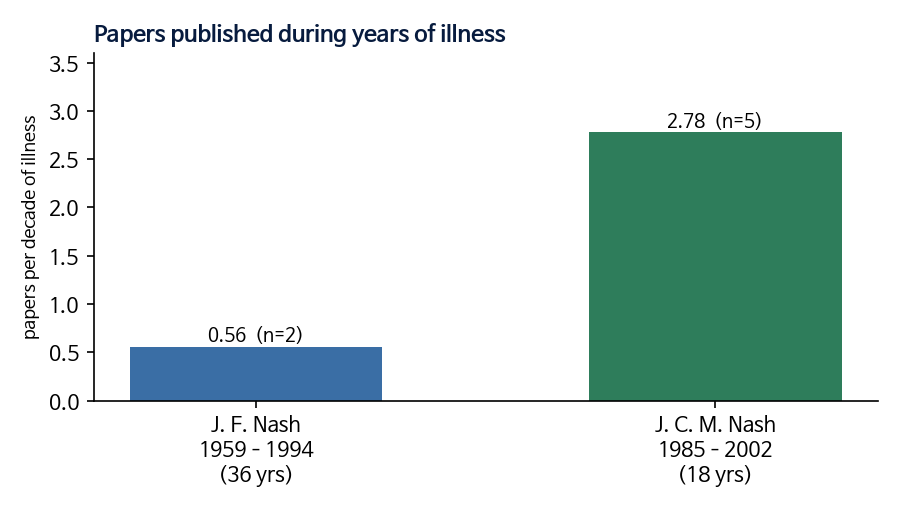
We compiled every peer-reviewed paper we could verify for the three adults of one household — the mathematician and economist John F. Nash Jr. (1928–2015), his son John Charles Martin Nash (b. 1959), and his wife Alicia Lardé Nash (1933–2015) — and matched each record to OpenAlex citation counts on 5 October 2026. The father’s 23 papers split cleanly: 14 appeared in the nine years 1950–1958, and four game-theory papers of 1950–1953 carry 25,382 of the 29,131 citations we could count (87%). During his illness (1959 to the 1994 Nobel Prize) only two new papers appeared, a rate of 0.56 per decade. The son, who developed the same illness in adolescence and never finished high school, published his Rutgers PhD work and four further papers in additive number theory over 1985–2002 — 2.78 per decade, five times his father’s rate during illness — and one of his bounds was still being cited and improved in 2009. For Alicia Nash, an MIT physics graduate of 1955, we found no indexed scholarly record at all, although her paternal grandfather (1925) and her aunt (1927) both appear in Crossref. We argue that this absence is a measurement of the scholarly record’s blind spot, not of her work, and we state what the record cannot show.
1 Why count a family
The film A Beautiful Mind (2001) and Sylvia Nasar’s biography (1998) made John Nash’s life famous. Both tell it as one man’s story. The published record tells a different story: three adults lived in one house in Princeton, two of them were mathematicians with the same diagnosis, and the third supported both for decades with a physics degree she never used in print.
We asked a narrow, checkable question: what does the scholarly record itself contain for each of the three, and what does it leave out? We did not interview anyone, and we used no private material. Every number below can be re-derived from the sources listed in §8.
2 Data and method
Corpus. For John F. Nash Jr. we took the bibliography maintained in the English Wikipedia article (accessed 2026-10-05) and checked each item against its journal record. It lists 23 published items from 1945 to 2012, plus an edited book (2016) that we exclude from counts. His 1950 Princeton thesis and his 1955 letter to the U.S. National Security Agency (declassified 2012) are not counted, because neither was a journal publication. For John C. M. Nash we used the Mathematics Genealogy Project (id 6016; PhD, Rutgers University, New Brunswick, 1985; advisor Melvyn B. Nathanson) and zbMATH author records, which list five papers. For Alicia Nash we searched MIT’s DSpace repository (theses and papers) and Crossref for “Alicia Nash”, “Alicia Larde” and “Lardé”.
Citations. Each title was matched in OpenAlex with a ±1-year window and an author-name check. Two automatic matches were wrong and were corrected by hand (§7). Four items are not indexed and are shown as such rather than given zero.
Periods. “Illness years” for the father run from the 1959 hospitalisation to the 1994 Nobel autobiography, in which he described his recovery. This is a convention: the remission began gradually in the 1980s, and any cut-off is arbitrary. For the son we count from his first paper (1985) to his last (2002). These windows answer different questions — we return to this in §6.
3 John F. Nash Jr.: nine years, two fields
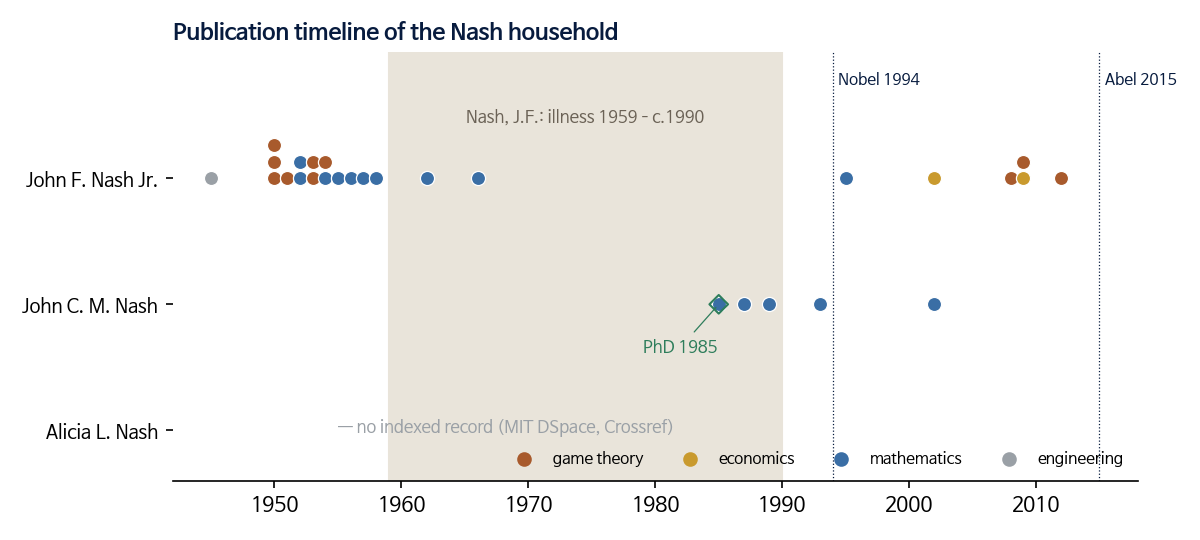
Fourteen of the father’s 23 papers appeared between 1950 and 1958, and they belong to two fields that rarely share an author.
Game theory and economics (1950–1953). Equilibrium points in n-person games (PNAS, 1950) is one page long. It proves that every finite game has at least one equilibrium in mixed strategies, using Kakutani’s fixed-point theorem. Non-cooperative games (Annals of Mathematics, 1951) gives the full argument with Brouwer’s theorem. The bargaining problem (Econometrica, 1950), begun as an undergraduate assignment, derives a unique bargaining outcome from four axioms; Two-person cooperative games (1953) starts the “Nash programme” of reducing cooperative games to non-cooperative ones. These are the papers cited in the 1994 Nobel Memorial Prize, shared with John Harsanyi and Reinhard Selten “for their pioneering analysis of equilibria in the theory of non-cooperative games”.
Geometry and analysis (1952–1958). Real algebraic manifolds (1952) shows that every compact smooth manifold is diffeomorphic to a component of a real algebraic variety. C¹ isometric imbeddings (1954) and The imbedding problem for Riemannian manifolds (1956) prove that any Riemannian manifold can be embedded isometrically in a Euclidean space; the second paper introduces the iteration now called the Nash–Moser technique. Continuity of solutions of parabolic and elliptic equations (1958) settles Hilbert’s nineteenth problem, independently of and slightly after Ennio De Giorgi. These are the papers cited in the 2015 Abel Prize, shared with Louis Nirenberg.
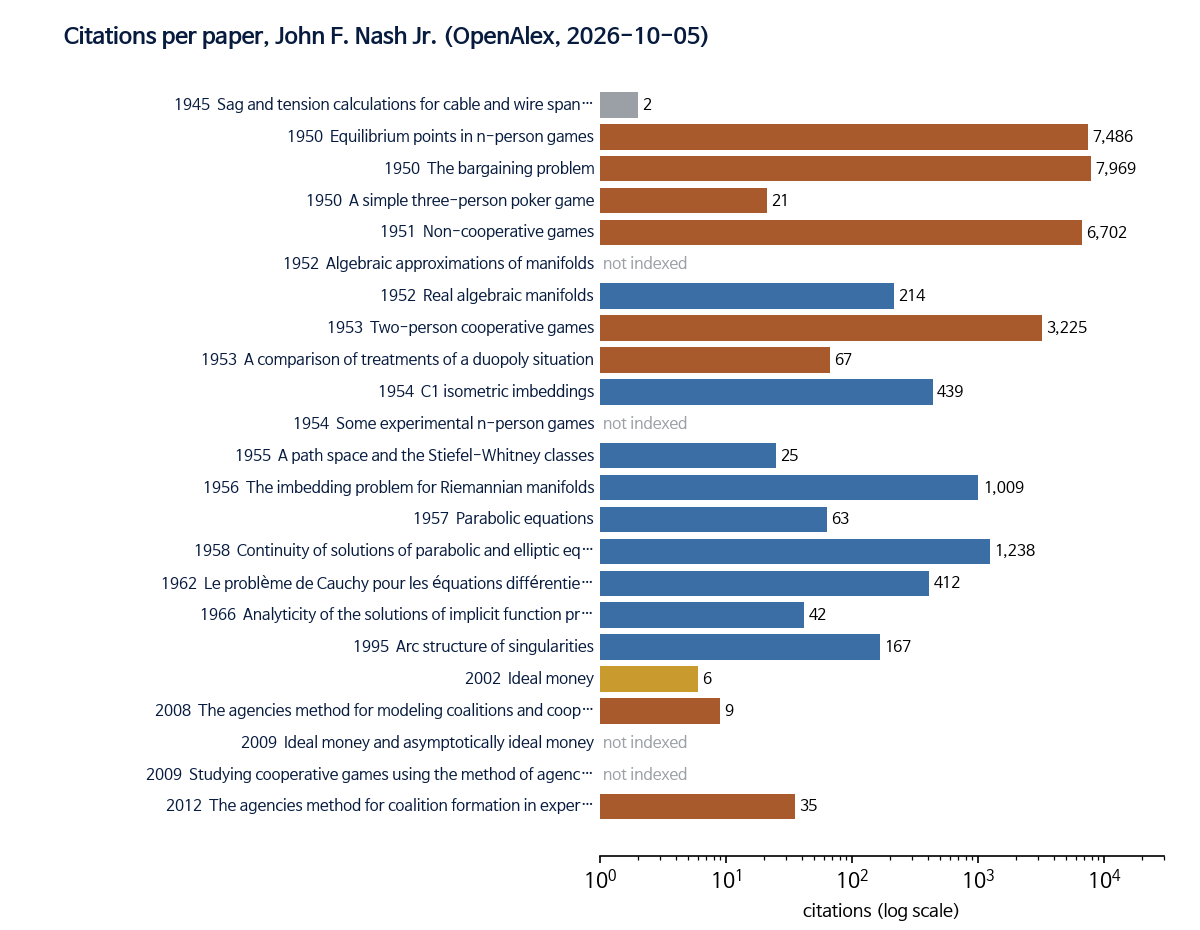
The citation record is lopsided. The four game-theory papers of 1950–1953 with more than 1,000 citations — Equilibrium points, The bargaining problem, Non-cooperative games and Two-person cooperative games — hold 25,382 of the 29,131 counted citations (87%). The 1956 embedding paper, which many mathematicians consider his deepest work, has 1,009. Citation counts measure how many fields use a result, not how hard it was to prove: economics, biology and computer science all cite the equilibrium theorem, while the embedding theorem is used mainly inside geometry and analysis.
Papers from “enforced rationality”. Three later mathematics papers — on the Cauchy problem for a general fluid (1962), on analyticity in implicit-function problems (1966), and Arc structure of singularities (Duke, 1995; written in 1968) — came, in Nash’s words, from “interludes of, as it were, enforced rationality” after months of involuntary hospitalisation (Nobel autobiography, 1994). The 1962 paper has 412 citations and the arc paper 167; the “Nash problem” on arcs it posed was shown false in dimension four and higher in 2003 (Ishii–Kollár) and proved for surfaces only in 2012 (Fernández de Bobadilla–Pe Pereira).
The late return to cooperation (2002–2012). After the Nobel Prize, Nash published on “ideal money” (2002, 2009) and on the “agencies method”, in which players delegate their decisions to agents and coalitions form step by step (2008, 2009, and a 2012 PNAS experiment with Rosemarie Nagel, Axel Ockenfels and Reinhard Selten). The author who made his name on non-cooperative games spent his last decade modelling cooperation.
4 John C. M. Nash: additive bases
Table 1 lists the son’s five papers.
| Year | Paper | Journal | OpenAlex citations |
|---|---|---|---|
| 1985 | Cofinite subsets of asymptotic bases for the positive integers (with M. B. Nathanson) | J. Number Theory | 18 |
| 1987 | Freiman’s theorem answers a question of Erdős | J. Number Theory | 2 |
| 1989 | On B₄-sequences | Canad. Math. Bull. | 5 |
| 1993 | Some applications of a theorem of M. Kneser | J. Number Theory | 11 |
| 2002 | Hyperperfect numbers | Period. Math. Hungar. | 5 |
The field is additive number theory. A set A of non-negative integers is an asymptotic basis of order h if every sufficiently large integer is a sum of h elements of A. The 1985 paper with his advisor asks what happens when a finite set X is removed from a basis: if A \ X is still a basis, how large can its order become? Nathanson and Nash gave upper bounds that grow as a polynomial in h of degree |X| + 1. In 2009 Bakir Farhi (arXiv:0902.3093) cited “the upper bounds of Nathanson and Nash”, restated Nash’s Proposition 3, and improved it for the case where X is an arithmetic progression. The 1987 and 1993 papers use the structural theorems of Freiman and Kneser on sumsets; the 1989 paper concerns B₄-sequences (sets in which all sums of four elements are distinct).
The thesis title is not recorded in the Mathematics Genealogy Project. A title circulating in search results (“Results on Bases in Additive Number Theory”) could not be traced to a primary record, so we do not use it.
5 Alicia Lardé Nash: an empty row
Alicia Esther Lardé López-Harrison was born in San Salvador in 1933, moved to the United States in 1944, and graduated in physics from MIT in 1955 as one of very few women in her class. Her later employers, as given in public biographies, were the Brookhaven Nuclear Development Corporation (laboratory physicist), RCA (aerospace engineer, laid off in the early 1960s), Con Edison (systems programmer) and New Jersey Transit (programmer and data analyst).
We found no indexed scholarly record under her names in MIT DSpace or Crossref. The same Crossref search returned her paternal grandfather, Jorge Lardé, for a 1925 study of the Izalco volcano, and her aunt, the poet Alice Lardé de Venturino, for a 1927 book. The family’s scholarly line is visible a generation before her and in her son after her; her own row is empty.
This is a statement about the databases. Industrial programming and laboratory work of the 1950s–1980s were rarely published under the employee’s name, undergraduate theses were not always deposited, and our search covered two indexes, not archives or company reports. What can be said is narrower and still useful: the work for which Alicia Nash is publicly known — keeping a household with two members diagnosed with schizophrenia housed, insured and stable for five decades, and later lobbying the New Jersey legislature on mental-health care — produces no record that a citation index can count.
6 What the record does not show (limitations)
- The two illness windows measure different things. The father’s 36 years include long hospital stays and a period with no academic post; the son’s 18 years begin only after he obtained a PhD and had an advisor. Figure 3 shows that serious illness and sustained publication coexisted in the son; it does not show that the son was “more productive”, and n = 2 and n = 5 are too small for any rate comparison to carry weight.
- OpenAlex undercounts older work and misses four of the father’s items; Google Scholar counts are several times higher. We use OpenAlex because it is open and reproducible, and we report its counts only as a snapshot.
- The bibliographies may be incomplete. The Wikipedia list may omit minor items; zbMATH may omit papers by the son outside its coverage.
- Absence is not evidence of no work (§5).
- No causal claim is made about schizophrenia and mathematical ability. Population studies report higher rates of scientific and artistic occupations among relatives of people with schizophrenia or bipolar disorder (e.g. Kyaga et al., 2011, 2013), but a single family cannot test that.
7 How this paper was made — the AI conversation and its corrections
The paper grew out of a long conversation between the editor and Claude (Anthropic) after the editor watched A Beautiful Mind. The editor asked the questions and decided what to publish; Claude searched, matched records, drew the figures and drafted the text. Several things were corrected along the way, and we list them because this journal publishes its corrections:
- The son’s thesis title. A search engine returned a specific title; the primary record (MGP) has the field blank. We dropped the title.
- Two wrong citation matches. OpenAlex first matched C¹ isometric imbeddings to a record with 0 citations and Studying cooperative games using the method of agencies (2009) to the 2008 agencies paper. Both were corrected by hand (439 citations; not indexed).
- Seat belts in the 2015 crash. Contemporary police statements said it was “unclear” whether the couple wore seat belts; Wikipedia states they did not. The question is outside this paper’s scope and we do not assert either.
- “Recovered without medication.” Nash wrote that he emerged “without medicine other than the natural hormonal changes of aging”; Nasar’s biography notes that his least symptomatic periods before recovery were on antipsychotic medication, and psychiatrists (Meltzer) caution against generalising. We report both.
- Numbers in the first draft. The first draft gave 15 papers for 1950–1958 and 25,450 citations for the game-theory papers. Recomputed from the raw data: 14 papers and 25,382 citations.
8 Sources and data
- Nash, J. F. Jr. (1994). Autobiography, Les Prix Nobel. Quoted via Wikipedia, “John Forbes Nash Jr.” (accessed 2026-10-05), which also supplied the bibliography.
- Mathematics Genealogy Project, id 6016: John Charles Martin Nash. Rutgers Experimental Mathematics Seminar page, 21 April 2005 (Zeilberger).
- zbMATH author records for “Nash, John C. M.”.
- OpenAlex API, queried 2026-10-05. The matched records, including OpenAlex IDs, are in
nash_papers_openalex.json(available from the editorial office). - Farhi, B. (2009). Upper bounds for the order of an additive basis obtained by removing a finite subset of a given basis. arXiv:0902.3093.
- MIT DSpace and Crossref searches, 2026-10-05.
- Wikipedia, “Alicia Nash” (accessed 2026-10-05).
- Capps, D. (2005). John Nash: Three phases in the career of a beautiful mind. J. Religion and Health 44, 363–376; Capps, D. (2011). John Nash, game theory, and the schizophrenic brain. J. Religion and Health 50, 145–162. doi:10.1007/s10943-009-9291-5.
- Brain & Behavior Research Foundation, webinar by H. Y. Meltzer, “A Beautiful Mind: John Nash, Schizophrenia, Game Theory and Recovery”.
- Nasar, S. (1998). A Beautiful Mind. Simon & Schuster.