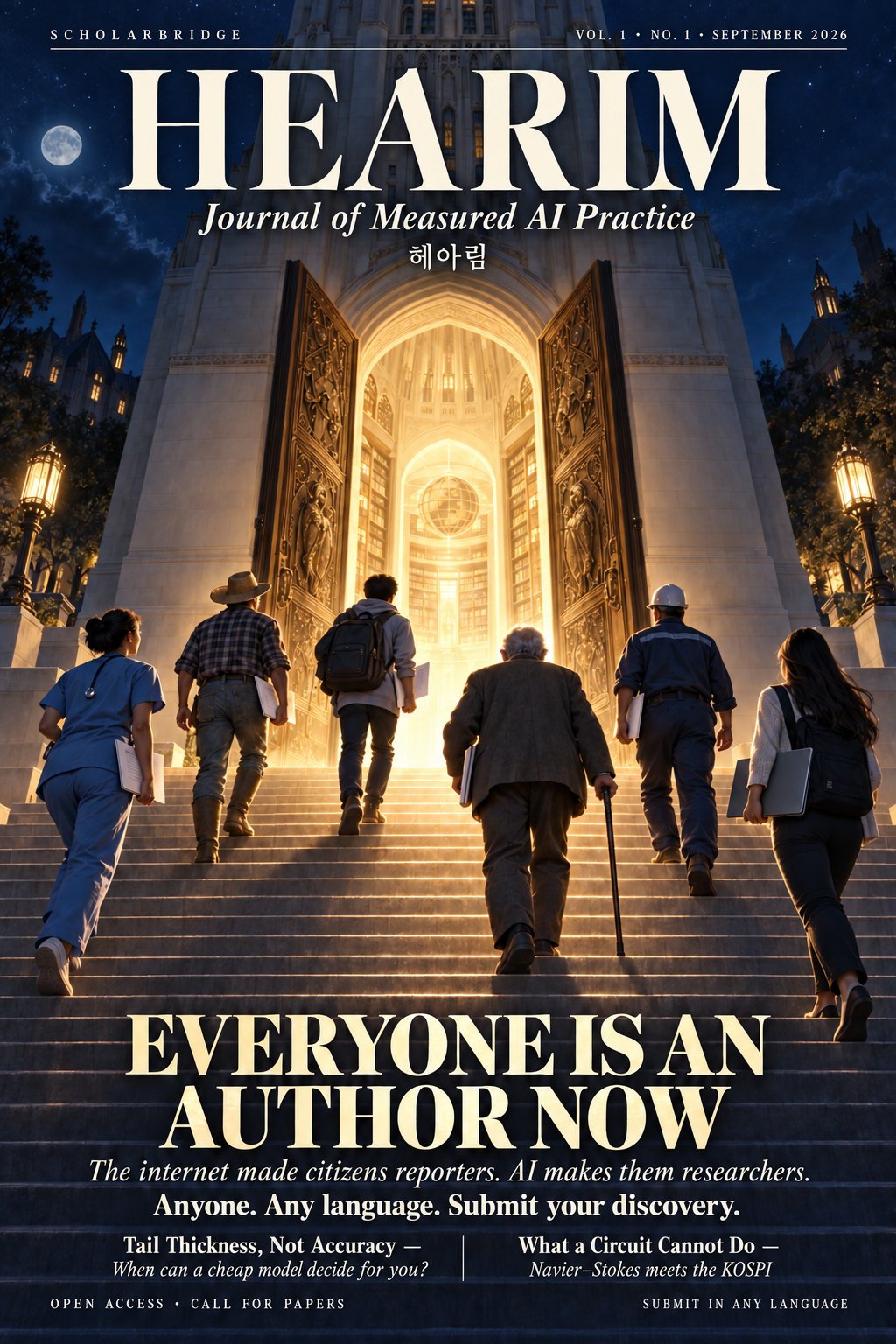
《HEARIM · 헤아림》Journal of Measured AI Practice
Every claim comes with a receipt.
We count, and we consider.
The AI-practice journal that counts the failures too.
Inside Vol. 1 · No. 1
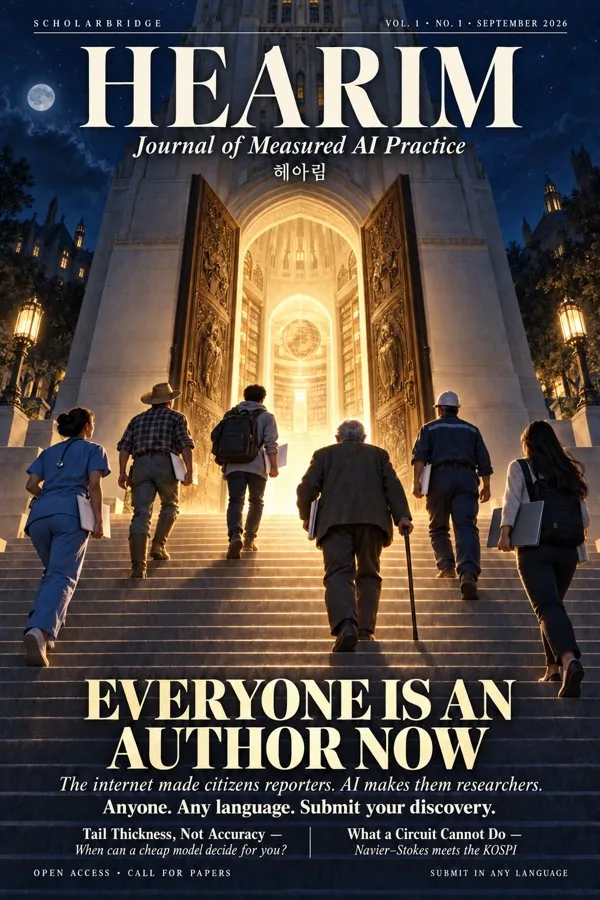
Anyone. Any language. Submit your discovery.

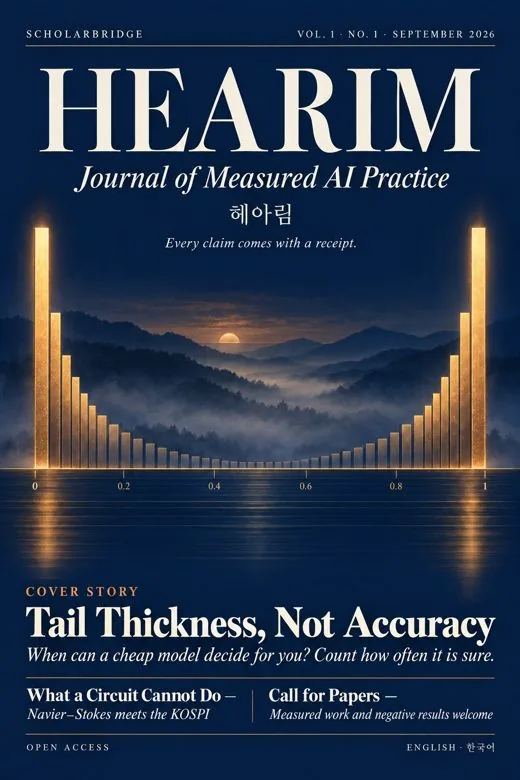
Cover story
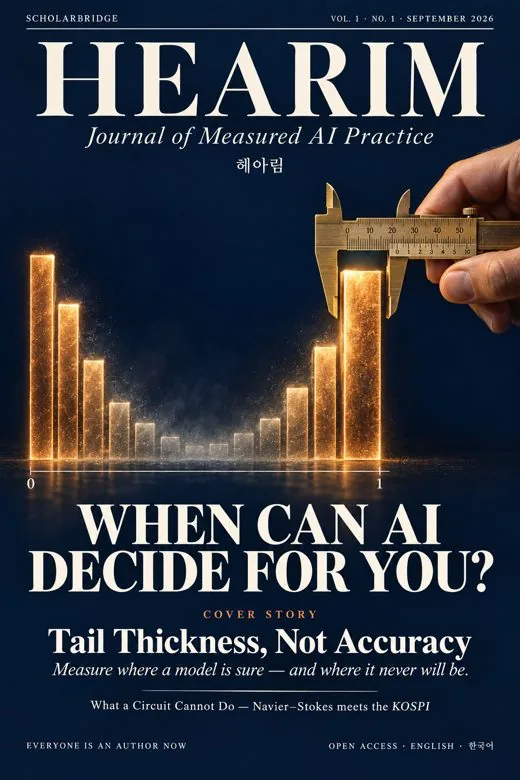
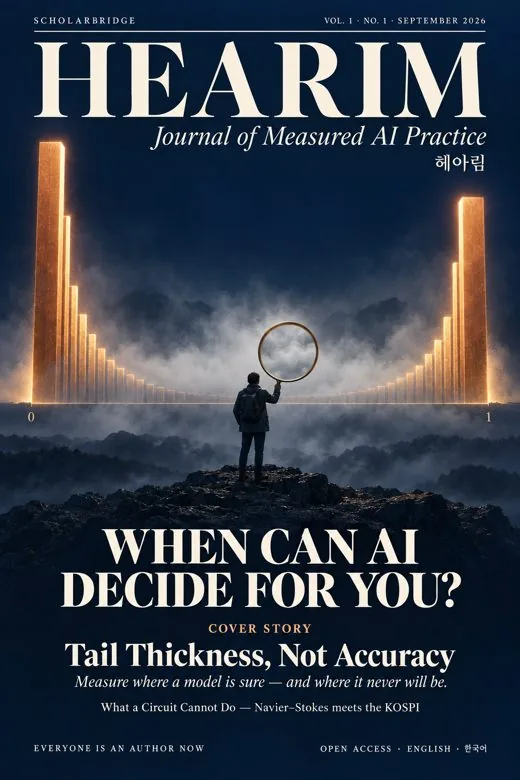
The two pillars glowing at either end are the inputs the judgment model was sure of — the tails. The valley in the fog is the middle it could not decide. How much cost a gate can remove is set by the thickness of the pillars. — Tail Thickness, Not Accuracy (p. 1)
Founding Statement — What We Owe the Freedom to Write
Under Japanese colonial rule, Koreans were tortured and killed for printing newspapers that carried the news to their neighbours. Under the military dictatorships, people were executed or spent decades in prison for nothing more than reading books together and talking about them.
Beautiful writing was born even then. Shin Young-bok spent twenty years in prison, pressing his thoughts into short, censored letters that became Reflections from Prison. The poet Park No-hae kept writing through a courtroom where the prosecution asked for his death and through the prison years that followed. Every line had a price, so no line was wasted.
Korea has now entered the age of AI. Anyone can publish. No one stops the writing, and no one is punished for it. AI will produce as many sentences as we ask for. The distance travelled in one lifetime is hard to take in.
But freedom brings a new danger. Once the danger was prison; now it is an endless flood of writing that no one reads. That anyone can write also means that any single piece of writing can weigh less.
For them, the constraints came from outside. We have to set our own. HEARIM is where we make that promise — not a censorship that silences people, but a discipline that gives writing weight: a receipt for every claim, errors named as errors, and AI-made sentences worked into something a person will want to read.
Some people won the freedom to write at the risk of their lives. What the generations who inherited it owe them is not to let that freedom dissolve into noise.
September 2026
Nakcho Choi, Editor
Editor's note — Why this is our first paper
HEARIM's first paper does not praise an AI. It is a human measuring the limits of an AI judgment model (Jev) with data.
The starting question was simple: can we hand decisions to a cheap AI that reports probabilities? The vendor said it was well calibrated. The author did not take that on trust. Working in conversation with AI, the author tested it on real e-mails and paragraphs — and found something unexpected: the model commits on factual questions but never commits on questions that involve taste (tail thickness 0%).
The criteria were fixed before the data were opened, and an earlier wrong verdict and an overstated number were corrected inside the paper itself.
Discovery · discussion · data · logic — all four things this journal asks for. It is our first example of thinking with AI rather than being led by it.
Special Issue No. 1 · October 2026
- SI-1Review & Bibliometric NoteThree Records, One Household: A Bibliometric Reading of John F. Nash Jr., John C. M. Nash, and the Unindexed Work of Alicia Nash세 개의 기록, 한 가정: 존 F. 내시, 존 C. M. 내시, 그리고 색인되지 않은 알리샤 내시의 일에 대한 계량서지학적 독해Nakcho Choi · with Claude
Contents · Vol.1 No.1 · September 2026
- p. 1Research ArticleTail Thickness, Not Accuracy: A Label-Free Screen for Delegating Judgments to Cheap Probability Models정확도가 아니라 꼬리 두께다: 저가 확률 모델에 판단을 위임할지 가리는 레이블 없는 선별 지표Nakcho Choi
- p. 2Research ArticleWhat a Circuit Cannot Do: Locating the Term that Carries Multifractality in Capital Flow, and the Portfolio Consequences of Finding It회로가 할 수 없는 것: 자본 흐름의 다중프랙탈성을 실어 나르는 항의 위치와, 그것을 찾아낸 뒤의 포트폴리오 귀결Nakcho Choi
- FORTHCOMING AFTER REVIEWResearch ArticlePublic AI as Social Infrastructure: A Heterogeneous-Agent Model of Access, Occupational Reallocation, and Economic PolarizationNakcho ChoiUnder review (ISTANS paper competition; JASSS). Full text will appear after review.
ISSN: to be applied for
Editor: Nakcho Choi · Publisher: ScholarBridge
Editorial office: scholarbridge2026@gmail.com
Why we built HEARIM
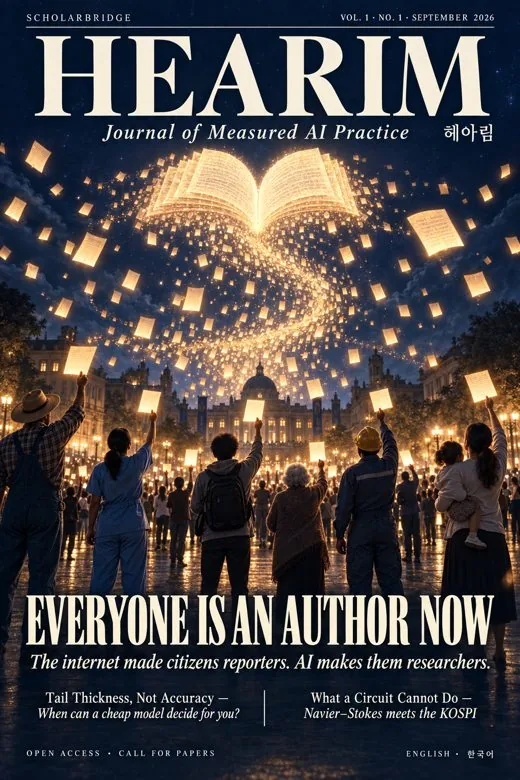
The internet made citizens reporters. AI makes them researchers.
But copying down what an AI says is not authorship. Being led by AI is different from thinking with it.
HEARIM publishes work by people who, through deep conversation with AI, discovered something they had not realized before, then argued with the AI, tested the finding, and turned it into new value.
Anyone may submit and be reviewed — a primary-school student or a retiree, with or without a degree or an institution.
We built this journal hoping that AI will help people build a better future, not replace them in it.
What we publish — all four
- Discovery. Something you did not know before the conversation. Say what changed.
- Discussion. You challenged, tested and revised the AI's answers — show the trace (conversation excerpts).
- Data. Every claim rests on real data or a source anyone can re-check. No conclusions from synthetic examples alone; raw data and code are released, except personal information and employer material.
- Logic. Question → method → result → limitations. Decision criteria are written before the data are opened (pre-registered, hashed). Falsified hypotheses and corrections are published too; corrections keep the original version history.
Open to everyone
- Age, degree, affiliation and nationality do not matter. Write in any language — AI reads and translates it, and your original is published alongside.
- Review is kind: if we cannot publish, we tell you concretely what would make it publishable.
- Authors under 14 need a guardian's consent (privacy). Pen names are allowed.
Operations
- Free to read and free to publish — no submission or subscription fees.
- Each article states the scope of AI use.
- © 2026 the authors. (A licence will be chosen later.)